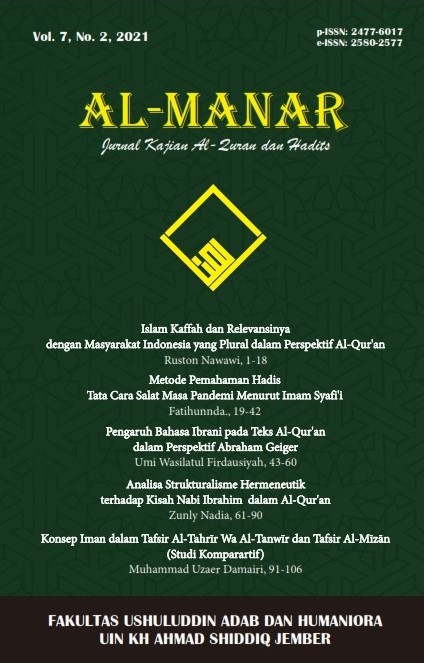
al-Ulama al-Indonesiun fi Dirasah al-Hadits al-Mu'ashirah
DOI:
https://doi.org/10.35719/amn.v7i2.19Kata Kunci:
وفيق الحكيم، , ضائل رمضان،, ريج, العلماء الإندونيسيينAbstrak
Ramadan is the ninth month of the Hijri month. A month in which the Qur’an was revealed, forgiveness and mercy, so there are many scholars throughout the Islamic world recently and in the past who are interested in this month. One of them is Indonesian Islamic scholar, Syaikh Taufiq Hakim. He wrote a book called "The Virtues of Ramadan". The author quoted in his book fifty hadiths on the merit of Ramadan. However, the author transmitted these hadiths without mentioning their source, chain of transmission, and authenticity of hadith. Therefore, this research was carried out to find out the truth about the sources of these hadiths and the degree of their validity. This research is focused on the first twenty-five hadiths from his book. This research aims to know the authenticity of the hadith mentioned in the book with two points: First, to verify the authenticity of the hadiths identified by numbers - that is, the first hadith to the twenty-fifth -which the author narrated. Second, track the location of the hadith and select proof of the hadith ruling. After the research, the researcher found twenty-five hadiths: five of them are authentic, nine of them are weak, four of them are fabricated, and seven of them have no basis.
Unduhan
Referensi
Abu Utsman Kharisman, Ramadhan Bertabur Berkah, (Penerbit: Pustaka Hudaya, 1434 H/2013 M), Cet. 1.
Ahmad Farih Dzakiy, Hadis Dan Resepsi Estetis Pesantren (Studi Kitab Fadail Ramadan Karya Taufiqul Hakim), Dalam Analisis, Vol. Xvi, No. 1 Tahun 2016.
Ali Mustafa Yaqub, Hadis-Hadis Palsu Seputar Ramadan, (Jakarta: Pustaka Firdaus, 2018)
Andi Rahman, Jurnal Studi Hadis: Pengenalan Atas Takhrij Hadis, Dalam Jurnal Studi Hadis Vol. 2 No. 1 Tahun 2016.
Farhan Maksudi, Pandangan K.H. Taufiqul Hakim Tentang Radikalisme Dalam Kitab Syifa Al-Ummah, Dalam Jurnal Pendidikan Islam Dan Bahas Arab, Vol.Ii,No. 1, Tahun 2019.
Jamal Ma’mur Asmani, Sang Pembaharu Pendidikan Pesantren, (Jepara: Pondok Pesantren Darul Falah, 2019).
M. Misbah, “Taufiqul Hakim “Amtsilati” Dan Pengajaran Nahwu-Sharaf”, Dalam Jurnal PemikiranAlternative Kependidikan Insania,Vol. 11,No. 3, Tahun 200.
M. Syuhudi Ismail, Metodologi Penelitian Hadis Nabi, (Jakarta: Bulan Bintang, 2016).
Moh. Ngindi Vadlullah, Dakwah Bil Qalam Kh. Taufikul Hakim Dalam Serial Buku Syifaul UmmahMuhammad Nur Siregar, Reinterpretasi Hadis Tentang Keutamaan Bulan Rajab Sya”Ban Dan Ramadan, Dalam Jurnal Kewahyuan Islam, Tahun 2017.
Taufiqul Hakim, Tawaran Rekontruksi System Pendidikan Nasional (Jepara: Pondok Pesantren Darul Falah: 2004).
Pahrudin, Ade. “The Rules and Criteria in Recognizing of Fabricated Hadiths: on Ibn Qayyim Through His Book Manarul Munif | ضوابط معرفة الحديث الموضوع عند ابن القيم في كتابه المنار المنيف.” AL-Zahra: Journal for Islamic and Arabic Studies13, no. 1 (November 29, 2018).
Unduhan
Diterbitkan
Cara Mengutip
Terbitan
Bagian
Lisensi
Hak Cipta (c) 2021 Ade Pahrudin

Artikel ini berlisensi Creative Commons Attribution-NonCommercial 4.0 International License.
1. Author’s Warranties
The author warrants that the article is original, written by the stated author/s, has not been published before, contains no unlawful statements, does not infringe the rights of others, is subject to copyright that is vested exclusively in the author, and free of any third party rights, and that any necessary written permissions to quote from other sources have been obtained by the author(s).
2. Miscellaneous
Al-Manar will publish the article (or have it published) in the journal if its editorial process is successfully completed and Al-Manar or its sublicensee has become obligated to publish it. Al-Manar may conform the article to a style of punctuation, spelling, capitalization, and usage that it deems appropriate.
Copyright
Authors retain copyright and grant the journal right of first publication with the work simultaneously licensed under an Attribution-NonCommercial 4.0 International (CC BY-NC 4.0) that allows others to share — copy and redistribute the material in any medium or format, Adapt — remix, transform, and build upon the material.

This work is based on licensed under Attribution-NonCommercial 4.0 International (CC BY-NC 4.0).










 This work is licensed under an