
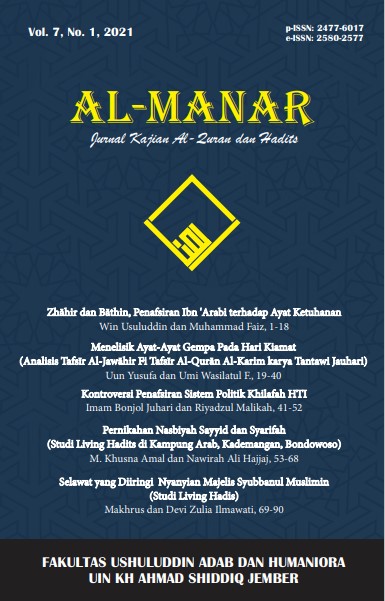
Zhāhir dan Bāthin, Penafsiran Ibn ‘Arabi terhadap Ayat Ketuhanan
DOI:
https://doi.org/10.35719/amn.v7i1.2Keywords:
zhāhir, bāthin, Ayat Ketuhanan, Ibn ‘ArabiAbstract
The verses of the Qur'an are believed to contain several meanings, among which are the substances known as the meanings of zhāhir and bāthin. But in practice, in the interpretation of ahkam (fiqh), for example, it is more of His zahir meaning than His inner meaning. At the same time, the interpretation of Sufism has more inner meaning than zhāhir. In the theology that impacts the things that happened to Ibn Arabi, he is stated by some scholars because of his collaborative concept of divinity. However, many ulama'-ulama' also understand the true meaning of Ibn Arabi's teaching because it is considered a form of interpretation based on zhāhir and zāthin. Based on this, the focus of the problem of this research is, first, how is zhāhir and bāthin in Ibn Arabi's perspective, and second, how is zhāhir and bāthin in Ibn Arabi towards the divine verse. This research uses an approach with a descriptive-analytical method, and the type of research is library research. The results of this study are: first, zhāhir and bāthin Ibn Arabi's perspective is a duality concept that cannot be separated, especially in the realm of Sufism; second, Ibn Arabi in overseeing the divine verse, which is a representation of His Wahdat al-Wujūd, does not balance meaning and balance and the two run in harmony.
Downloads
References
Addas, Claude. Mencari Belerang Merah, KisahHidup Ibn Arabi, terj Zaimul Am, (Jakarta: Serambi, 2004)
Azhari Noer, Kautsar. Ibn Arabi :Wahdat Wujūd dalam Perdebatan, (Paramadina: Jakarta,1995)
Cecep Alba, “Corak Tafsir Al-Qur’an Ibn Arabi”, Jurnal Sosiotekhnologi, Edisi 21 Tahun 9, Desember 2010
Dzahabi, Husain, Tafsir wa al-Mufassirun, (Kairo : Maktabah Wahbah)
Schimmel, Annimari, Dimensi Mistik dalam Islam, Terj. Achadiati Ikram (Jakarta : Pustaka Firdaus 1986)
Ibn Arabi, Muhyi al-Din. Fushūsh al-Hikam, (Mesir: Mustafa al-Babi, 2010)
-----. Al-Futuhāt al-Makkiyah, (Al-Hai’ah al-Mishriyah, 1985)
-----. Tarjuman al-Asywaq, (Beirut: Dar al-Ma’rifat, 2005)
-----. Tafsir al-Qur’an al-Karim, (Beirut: Dar al-Kutub Ilmiyah, 2011)
M.Abdul Halim dkk, Eksiklopedi Tematis Islam, (Bandung: Mizan, 2003)
Muhammad al-Fayyad, “Teologi Negatif Ibn Arabi: Sebuah Kritik Metafisika”, (Skripsi, UIN Sunan Kali Jaga, Yogyakarta, 2009)
Muhammad Zainal Muttaqin, “Corak Tafsir Sufistik: Studi Analisis atas Tafsir Ruhul Bayan Karya Isma’il Haqqi”, (Tesis, UIN Syarif Hidayatullah, Yogyakarta, 2010)
Sutrisno. Fazlurrahman: Kajian terhadap metode Epistemologi dan Sistem Pendidikan, (Pustaka Pelajar: Yogyakarta, 2006)
Uswatun Hasanah, “Konsep Wahdat Al-Wujūd Ibn’arabi Dan Manunggaling Kawulo Lan Gusti Ranggawarsita” (Skripsi,UIN Wali Songo, Semarang 2015)
Downloads
Published
How to Cite
Issue
Section
License
Copyright (c) 2021 almanar almanar

This work is licensed under a Creative Commons Attribution-NonCommercial 4.0 International License.
1. Author’s Warranties
The author warrants that the article is original, written by the stated author/s, has not been published before, contains no unlawful statements, does not infringe the rights of others, is subject to copyright that is vested exclusively in the author, and free of any third party rights, and that any necessary written permissions to quote from other sources have been obtained by the author(s).
2. Miscellaneous
Al-Manar will publish the article (or have it published) in the journal if its editorial process is successfully completed and Al-Manar or its sublicensee has become obligated to publish it. Al-Manar may conform the article to a style of punctuation, spelling, capitalization, and usage that it deems appropriate.
Copyright
Authors retain copyright and grant the journal right of first publication with the work simultaneously licensed under an Attribution-NonCommercial 4.0 International (CC BY-NC 4.0) that allows others to share — copy and redistribute the material in any medium or format, Adapt — remix, transform, and build upon the material.

This work is based on licensed under Attribution-NonCommercial 4.0 International (CC BY-NC 4.0).












 This work is licensed under an