
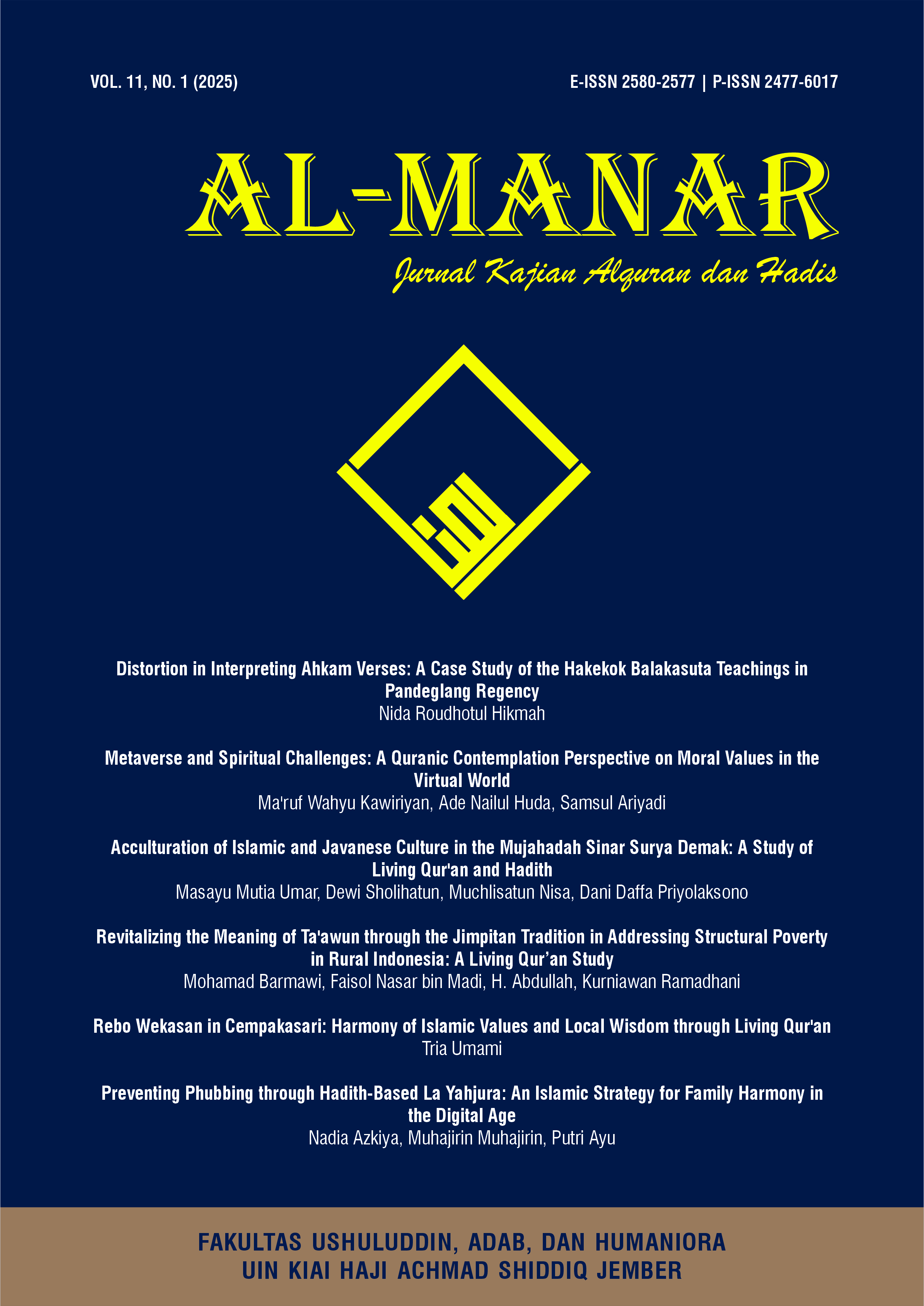
Distortion in Interpreting Ahkam Verses: A Case Study of the Hakekok Balakasuta Teachings in Pandeglang Regency
(Distorsi Penafsiran Ayat-ayat Ahkam: Studi Kasus Ajaran Hakekok Balakasuta di Pandeglang)
DOI:
https://doi.org/10.35719/amn.v11i1.151الكلمات المفتاحية:
Hakekok Balakasuta، Distortion of Islamic Teachings، Interpretation of Legal Verses (Ahkam)، Living Qur'anالملخص
The emergence of the Hakekok Balakasuta teaching in Pandeglang Regency, Indonesia, has raised concerns due to its deviation from mainstream Islamic teachings, particularly in the interpretation of ahkam (legal) verses in the Quran. Rooted in the Sunda Wiwitan belief system and founded by Arya in 2021, this spiritual group promotes practices that contradict orthodox Islam, such as altering the shahada (declaration of faith), deeming the five daily prayers non-obligatory, and introducing unconventional rituals, including communal bathing without proper attire, as a form of purification. The primary issues revolve around distorted interpretations of worship practices, including prayer, fasting, zakat (alms), and purification, which misalign with Quranic injunctions and lead to potential religious fragmentation in the community. This study aims to examine the forms of distortion in interpreting ahkam verses within Hakekok Balakasuta teachings and identify the underlying causes. Employing a qualitative descriptive approach rooted in Living Qur'an studies, the research utilized direct observation, in-depth interviews, and documentation as primary data sources from Karangbolong, Pandeglang Regency. Secondary data were drawn from books, journals, tafsirs (Quranic commentaries), and relevant literature. Findings reveal specific distortions, such as viewing prayer as optional rather than obligatory, fasting practices diverging from Islamic norms, and the communal bathing ritual as self-purification, which lacks a scriptural basis. Contributing factors include economic hardships, low educational levels, and insufficient religious awareness among followers. The study highlights the importance of enhancing Islamic education to prevent such deviations and promote accurate Quranic interpretation.
التنزيلات
المراجع
Adib, Noblana. “Faktor-faktor Penyebab Penyimpangan dalam Penafsiran al-Qur’an.” Mawa'izh: Jurnal Dakwah dan Pengembangan Sosial Kemanusiaan 8, no. 1, (2017): 1-30. https://doi.org/10.32923/maw.v8i1.694
al-Hatiri, Abdul Ghaffar (Sekretariat MUI Kabupaten Pandeglang). Interview by Nida Roudhotul Hikmah, Pandeglang, 11 Januari 2022.
Ali, Lukman. Kamus Besar Bahasa Indonesia. Jakarta: PT. Raja Grafindo Persada, 1996.
Alu Syaikh, Abdullah bin Muhammad bin Abdurahman. Tafsir Ibnu Katsîr. Jakarta: Pustaka Imam asy-Syafi’i, 2008.
Amin, Mohd Farhan bin Md., Maizuddin Maizuddin, and Hisyami bin Yazid. “Penyim-pangan dalam Penafsiran Al-Qur’an: Analisis Penafsiran Kelompok Millah Ibrahim.” TAFSE: Journal of Qur’anic Studies 5, no. 1 (2020): 1-16. https://doi.org/10.22373/tafse.v5i1.12887
Andryanto, S. Dian. “Geger Aliran Hakekok Balakasuta Ajaran Sesat dari Pandeg-lang.” Tempo.co, 13 Maret 2021. https://nasional.tempo.co/read/1441785/geger-aliran-hakekok-balakasuta-ajaran-sesat-dari-pandeglang/
Ani (Peganut Aliran Hakekok Balakasuta). Interview by Nida Roudhotul Hikmah. Pandeglang, 29 Mei 2022.
Ariyanti, Mega. “Konsep Tirakat Puasa Kejawen Bagi Penghayat Kepercayaan Kejawen.” Seminar Internasional Riksa Bahasa XIII, Universitas Gadjah Mada Yogyakarta (2019).
Basalamah, A.M. Kejamkah Hukum Islam. Jakarta: Gema Insani Press, 1992.
Bukhari, Imam. Shohih Bukhari. Beirut: Daar Ibnu Katsir, 2002.
Hanbal, Imam Ahmad bin Muhammad bin. Al-Musnad al-Imam Ahmad bin Hanbal. Kairo: Dârul Hadis, 1995.
Hasbillah, Ahmad ‘Ubaydi. Ilmu Living Qur’an-Hadis Ontologi, Epistemologi, dan Aksiologi. Tangerang Selatan: Unit Penerbitan Maktabah Darus-Sunnah, 2019.
Jalaluddin, H. Psikologi Agama. Jakarta: PT Raja Grafindo Persada, 2007.
Kartapradja, Kamil. Aliran Kebathinan dan Kepercayaan di Indonesia. Jakarta: CV Haji Masagung, 1990.
Kasdi, Abdurrahman. Tafsir Ayat-ayat Ahkam. Jakarta: Pustaka al-Kautsar, 2014.
Lubis, Nisa Idriani. “Pandangan MUI Kota Medan Terhadap Penyimpangan Aqidah Islam Dalam Masyarakat”. Skripsi. Universitas Islam Negeri Sumatera Utara Medan, 2020.
Mahardika, Teguh. “Heboh Aliran Hakdzat Shalatnya Menghadap 4 Arah Mata Angin.” Okezone.com, 29 September 2021. https://news.okezone.com/read/ 2021/09/29/340/2478411/heboh-aliran-hakdzat-di-pandeglang-sholatnya-menghadap-4-arah-mata-angin
Maleteng, Dahlia. Implikasi Do’a Terhadap Kesehatan Jiwa. Jakarta: Institut Ilmu Al-Qur’an (IIQ) Jakarta, 2020.
Nurusshoumi, Ainita. “Penyimpangan dalam Tafsir: Kajian Unsur al-Dakhil dalam Tafsir al-Qummi Karya Ali bin Ibrahim al-Qummi.” Al-Tadabbur: Jurnal Ilmu Qur’an dan Tafsir 6, no. 2 (2021): 275–294. https://jurnal.staialhidayahbogor. ac.id/index.php/alt/article/view/1484
Qaradhawi, Yusuf. Halal dan Haram. Bandung: Penerbit Jabal, 2007.
Rifai, Ahmad. “Kesalahan dan Penyimpangan dalam Tafsir.” Al Amin: Jurnal Kajian Ilmu dan Budaya Islam 2, no. 2, (2019): 130-148. Retrieved from https://www.researchgate.net/publication/336582111_kesalahan_dan_penyimpangan_dalam_tafsir
Rusmana, Dadan. Metode Penelitian Al-Qur’an dan Tafsir. Bandung: CV. Pustaka Setia, 2015.
Shihab, M. Quraish. Kosakata Keagamaan. Tangerang Selatan: Penerbit Lentera Hati, 2020.
Shihab, M. Quraish. Tafsir al-Misbah. Jakarta: Lentera Hati, 2002.
Soetomo. “6 Fakta Aliran Hakekok Balakasuta: Mandi Bareng Tanpa Busana.” JPPN.com, 20 Maret 2021. https://www.jpnn.com/news/6-fakta-aliran-hakekok-balakasuta-mandi-bareng-tanpa-busana-ke-5-bikin-kaget-juga
Sulhadi, Asep. “Mengenal Ayat-ayat Hukum dalam al-Qur’an.” Samawat: Journal of Hadith and Qur'anic Studies 1, no. 1 (2017): 1-9. https://ejournal.badrussholeh.ac.id/index.php/samawat/article/view/104
Syamsudin, Sahiron. Metodologi Penelitian Living Qur’an. Yogyakarta: Penerbit Teras, 2007.
Syuaib, M. Ridwan Sanusi, dan M. Roief. Klasifikasi Ayat-Ayat Al-Qur’an. Jakarta: Insida Lantabora, 2006.
Tamim, Ummu. Menyingkap Aliran dan Paham Sesat. Terj. Sufyan bin Zaidin Sinaga Abu Yazid. Yogyakarta: Pustaka Imam Ahmad, 2009.
Thahir, Mursyidah. Keindahan Al-Qur’an dan Fleksibilitas Fikih. Tangerang Selatan: Tazkiya Foundation, 2016.
Tim Direktorat Jenderal Pendidikan Islam Kementrian Agama RI. Ensiklopedi Islam Nusantara. Jakarta: Dirktorat Pendidikan Tinggi Keagamaan Islam.
Turmuzi, Wely Dozan, dan Muhammad. Sejarah Metodologi Ilmu Tafsir Al-Qur’an: Teori, Aplikasi, dan Model Penafsiran. Yogyakata: Bintang Pustaka Madani, 2020.
Zayd, Nasr Hamid Abu. Rethinking The Qur’an: Toward a Humanistic Hermeneutics. Amsterdam: SWP Publisher, 2004.
Zuhdi, Masjfuk. Studi Islam. Jakarta: CV. Rajawali, 1992.
التنزيلات
منشور
كيفية الاقتباس
إصدار
القسم
الرخصة
الحقوق الفكرية (c) 2025 Nida Roudhotul Hikmah

هذا العمل مرخص بموجب Creative Commons Attribution-NonCommercial 4.0 International License.
1. Author’s Warranties
The author warrants that the article is original, written by the stated author/s, has not been published before, contains no unlawful statements, does not infringe the rights of others, is subject to copyright that is vested exclusively in the author, and free of any third party rights, and that any necessary written permissions to quote from other sources have been obtained by the author(s).
2. Miscellaneous
Al-Manar will publish the article (or have it published) in the journal if its editorial process is successfully completed and Al-Manar or its sublicensee has become obligated to publish it. Al-Manar may conform the article to a style of punctuation, spelling, capitalization, and usage that it deems appropriate.
Copyright
Authors retain copyright and grant the journal right of first publication with the work simultaneously licensed under an Attribution-NonCommercial 4.0 International (CC BY-NC 4.0) that allows others to share — copy and redistribute the material in any medium or format, Adapt — remix, transform, and build upon the material.

This work is based on licensed under Attribution-NonCommercial 4.0 International (CC BY-NC 4.0).










 This work is licensed under an