
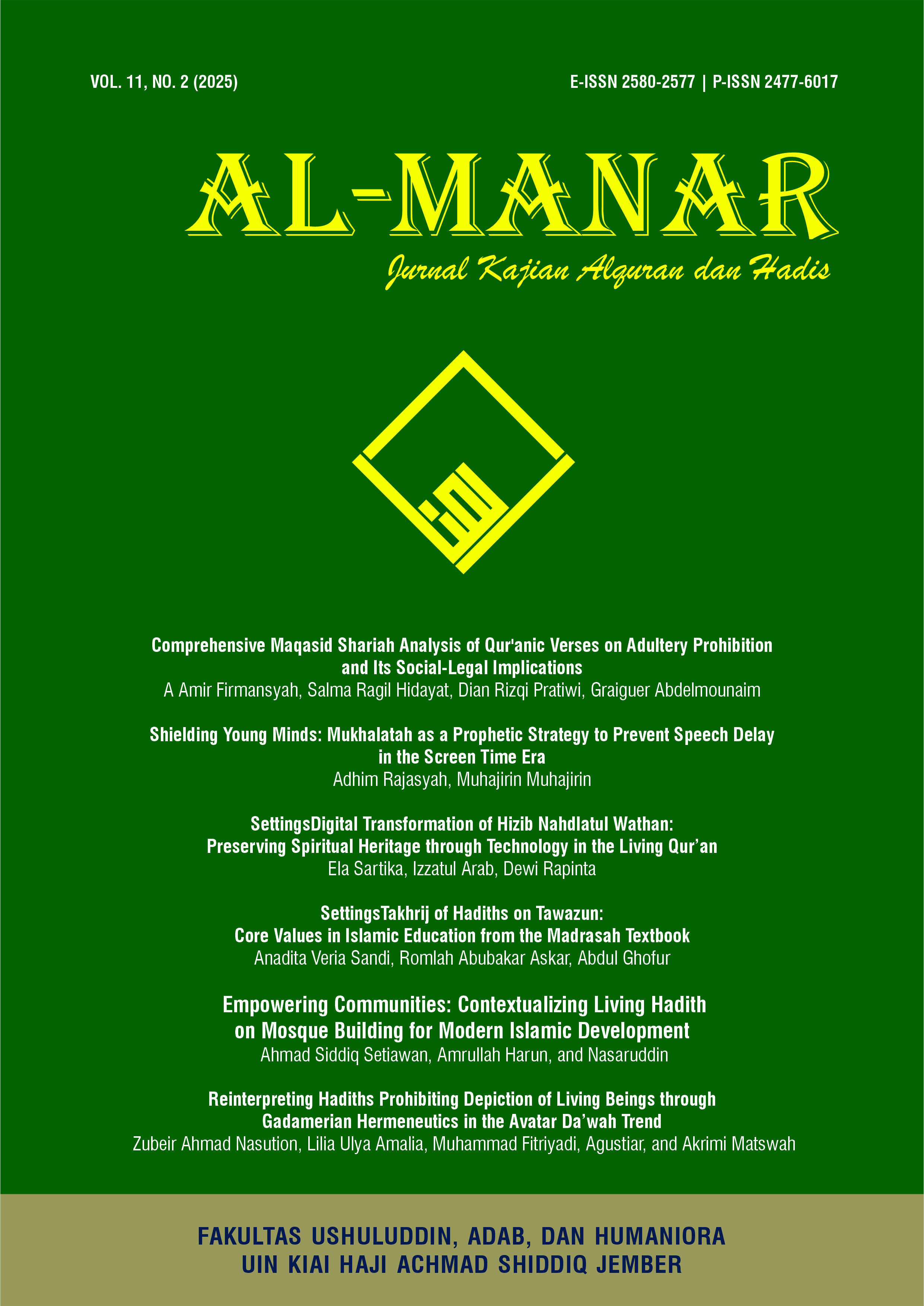
Takhrij of Hadiths on Tawazun: Core Values in Islamic Education from the Madrasah Textbook
DOI:
https://doi.org/10.35719/amn.v11i2.172Keywords:
Takhrīj Hadith, Tawāzun, Islamic Education, Madrasah Curriculum, Character BuildingAbstract
Tawāzun, or balance, is a core principle in Islamic education, emphasizing equilibrium between worldly and afterlife pursuits. In the Qur’an Hadith textbook for Grade VIII Madrasah Tsanawiyah, published by Indonesia’s Ministry of Religious Affairs (2020), two hadiths on tawāzun serve as foundational tools for fostering students' balanced spiritual and social character. This study conducts takhrīj on these hadiths using a library research approach and sanad-matn analysis to trace their origins, authenticity, and embedded Islamic educational values. Findings reveal that both hadiths originate from authoritative sources in the kutub al-tis‘ah, particularly Ṣaḥīḥ Muslim and Sunan al-Nasā’ī. The first hadith (the Prophet’s supplication for the rectification of religion, worldly life, and the hereafter), narrated from Abū Hurairah, has a continuous (muttaṣil) sanad with all thiqah narrators, rendering it ṣaḥīḥ li-dhātihi. The second hadith (the parable of the world likened to water on a finger dipped in the sea), narrated from Mustawrid, is transmitted through five reinforcing chains, also deemed ṣaḥīḥ despite minor non-impactful textual variants. The hadiths convey key Islamic educational values, including moderation, responsibility, physical-spiritual harmony, and holistic awareness of life’s purpose. They are highly relevant for Islamic character education in madrasahs, fostering balanced, optimistic, and hereafter-oriented attitudes amid contemporary challenges of modernization and hedonism. This research fills a gap in takhrīj studies on madrasah textbooks and strengthens the validity of Islamic religious education materials in Indonesia.
Downloads
References
Al-’Asqalāni, Ahmad ibn Alī ibn Muhammad al-Kinani. Tāhẓību al-Tāhẓīb, Juz I. Beirut: Muassasah al-Risālah, 2008.
_____. Tāhẓību al-Tāhẓīb, Juz II. Beirut: Muassasah al-Risālah, 2008.
_____. Tāhẓību al-Tāhẓīb, Juz III. Beirut: Muassasah al-Risālah, 2008.
_____. Tāhẓību al-Tāhẓīb, Juz IV. Beirut: Muassasah al-Risālah, 2008.
Al-Ghazali, Abu Hamid. Ihya’ Ulum al-Din. Beirut: Dar al-Ma‘rifah, 2020.
Al-Māzi, Yūsuf ibn Abdurrahman ibn Yūsuf. Tāhẓīb al-Kamāl fī Asmā al-Rijāl, Vol. 24. Beirut: Muassasah ar-Risalah, 1983.
Al-Munāwi, Muhammad Abd al-Rauf. Faiḍ al-Qadīr Syarah al-Jāmi’ al-Ṣagīr min Ḥadīṡ al-Basyīr al-Nażīr, Juz III. Beirut: Dār al-Kutub al-Ilmiyah, 2001.
Al-Naisābūrī, Imām Abī al-Husain Muslim ibn Hajjāj al-Qusyairī. Ṣahīh Muslim. 2nd Edition. Riyadh: Dār al-Ḥaḍārah Linnasyri wa al-Tauzī’, 2015.
Al-Nasā’i, Ahmad ibn Syu’aib ibn Alī ibn Sinān Abū Abdirrahmān. Sunan al-Nasā’i. Riyadh: Dār Ṭawīq Linnasyri wa al-Tauzī’, 2005.
Al-Nawawi, Imam. Syarah Ṣahīh Muslim, Vol. 12. Translated by Agus Ma’mun, Suharlan, and Suratman. 3rd edition. Jakarta: Dar al-Sunnah, 2013.
Awwaliyah, Neny Muthi’atul. “Analisis Kajian Takhrīj Hadis tentang Terbelenggunya Setan pada Bulan Ramadhan.” FITUA: Jurnal Studi Islam 3, no. 1 (2022). https://doi.org/10.47625/fitua.v3i1.359.
Dani, Rahmat, and Dea Jihanna Ilmi, “Klasifikasi Hadis Ditinjau dari Segi Kuantitas dan Kualitas Sanad.” Jurnal Kajian Pendidikan Islam 3, no. 2 (2024): 113–125. https://doi.org/10.58561/jkpi.v3i2.127.
Fahmi, Muhammad Azkia, Laode Muhammad Alfateh Arifin, and Rosyidatul Munawaroh. “Klasifikasi Hadis Berdasarkan Jumlah Sanad: Mutawatir, Ahad, Masyhur, ’Aziz, Ghorib.” SUAR: Jurnal Studi Pendidikan Islam 1, no. 1 (2025): 50–64. https://ejournal.unsera.ac.id/index.php/suar/article/view/154.
Ibn Miskawayh. Tahdhīb al-Akhlāq wa Taṭhīr al-A‘rāq. Beirut: Dar al-Kutub al-‘Ilmiyyah, 2017.
Karlina Reni, Frida Rohmatika, and M. Fitriadi. "Klasifikasi Hadist Ditinjau dari Segi Kualitas dan Kuantitas Sanad." Jurnal Kajian Islam dan Sosial Keagamaan 1, no. 4 (2024): 422–430. https://jurnal.ittc.web.id/index.php/jkis/article/view/1135.
Nu’man, Mohammad, and Junaedi Junaedi. “The Ethic of Spiritual and Material Balance (Tawāzun) in Classical Islam as a Solution to the Value Crisis of Modern Education.” Jurnal Edusci 3, no. 2 (2025): 162–181. https://doi.org/10.62885/edusci.v3i2.953
Ritonga, Muhammad Tohir. “Takhrīj Hadis tentang Tata cara Berpuasa.” At-Turots: Jurnal Pendidikan Islam 5, no. 1 (2023): 1–11. https://doi.org/10.51468/jpi.v3i1.56.
Sayyid Qutb. Islamic Concept of Balance in Life (Tawazun fi al-Hayah al-Islamiyyah). Cairo: Dar al-Shuruq, 2000.
Sidik, Usup. Al-Qur’an Hadis Kelas VIII Madrasah Tsanawiyah. Edited by Abdullah Aniq Nawawi. Jakarta: Kementerian Agama RI, 2020.
Ulya, Erviana Iradah, and Azalia Wardha Aziz. “Tawazun sebagai Prinsip Moderasi Beragama Perspektif Mufasir Moderat.” Ulumul Qur’an: Jurnal Ilmu Al-Qur’an dan Tafsir 4, no. 2 (2024): 290–308. https://doi.org/10.58404/uq.v4i2.344.
Utrianto, Utrianto. “Klasifikasi Hadis Ditinjau dari Segi Kuantitas dan Kualitas Sanad.” GHIROH 1, no. 2 (2022): 159–170. https://doi.org/10.61966/ghiroh.v1i2.24.
Wensinck, Arent Jan. al-Mu’jam al-Mufahras li Alfāẓil al-Hadīs an-Nabawī, Juz I. Leiden: Brill, 1936.
_____. Al-Mu’jam al-Mufahras li Alfāẓil al-Hadīs an-Nabawī, Juz III. Leiden: Brill, 1936.
Downloads
Published
How to Cite
Issue
Section
License
Copyright (c) 2025 Anadita Veria Sandi, Romlah Abubakar Askar, Abdul Ghofur

This work is licensed under a Creative Commons Attribution-NonCommercial 4.0 International License.
1. Author’s Warranties
The author warrants that the article is original, written by the stated author/s, has not been published before, contains no unlawful statements, does not infringe the rights of others, is subject to copyright that is vested exclusively in the author, and free of any third party rights, and that any necessary written permissions to quote from other sources have been obtained by the author(s).
2. Miscellaneous
Al-Manar will publish the article (or have it published) in the journal if its editorial process is successfully completed and Al-Manar or its sublicensee has become obligated to publish it. Al-Manar may conform the article to a style of punctuation, spelling, capitalization, and usage that it deems appropriate.
Copyright
Authors retain copyright and grant the journal right of first publication with the work simultaneously licensed under an Attribution-NonCommercial 4.0 International (CC BY-NC 4.0) that allows others to share — copy and redistribute the material in any medium or format, Adapt — remix, transform, and build upon the material.

This work is based on licensed under Attribution-NonCommercial 4.0 International (CC BY-NC 4.0).












 This work is licensed under an